
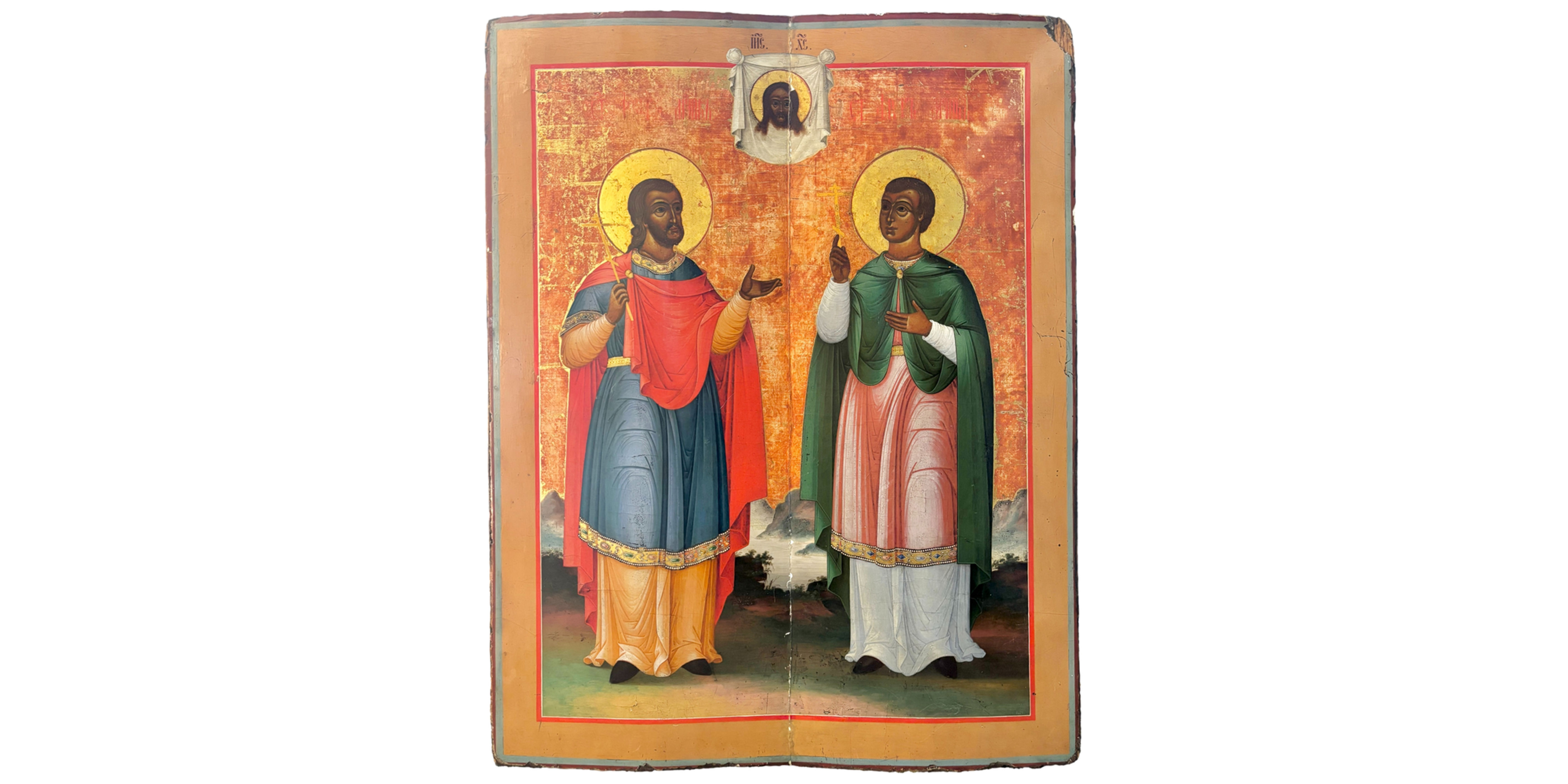

103310 | RUSSIA. Saints Florus and Laurus wooden Monumental Icon.
Details
103310 | RUSSIA. Saints Florus and Laurus wooden Monumental Icon. Made circa 1850-1870. (61.6cm x 78.7cm [24-1/4" x 31"], 7.62 kg [16.8 lbs]).
Nimbate saints Florus, bearded and wearing blue jeweled tunic with off-white undergarment and red cape, and Laurus, clean-shaven and wearing jeweled pink undergarment and green cloak, standing facing one another, each holding patriarchal cross; foggy mountainscape in lower background, with the Veil of Veronica (facing nimbate head of Jesus Christ upon a white veil) at the top; the saints are largely set against an orange backdrop with a thin red border, wider mango border, and thinner off-white border; in red and above Florus reads (in stylized Orthodox Cyrillic) CT ΦΛѠPЪ MЧИКЪ (St. Florus the martyr), and above Laurus reads CT ΛAVPЪ MЧИКЪ (St. Laurus the martyr), and in purple above Christ reads IИC XC (Jesus Christ)—all of which is painted in tempera atop two wooden panels (doski) that have been joined from the back (hence a central crease and light bowing as would be typical), with a good deal of golden shimmering throughout, and especially among the orange central backdrop. Back and sides: Wood exposed, with some scattered scuffs and marks; two slates (shponki) near the top and bottom for resistance; wire hinge affixed to the top shponka for use in suspension on a wall.
Extremely Fine. Some minor fraying of wood at the edge is noted, along some subsequent chipping of the tempera near those areas; a more noticeable chip of both wood and tempera can be seen at the upper right corner; some light rub near the central crease where the two panels (doski) were joined is seen, with some minor scuffs to the tempera throughout; overall, however, the condition, especially given its monumental and weighty size, is quite pleasing and the coloring in general is rather bold. Very minor warping of the two panels (doski) is observed, and as can often be the case, though with the shponki providing their support.
Please refer to the in-hand video in order to get a more accurate sense of the size of this icon, which is quite massive and also rather heavy. A rather impressive and imposing piece for one's wall.
Following the conversion of the peoples of the Ancient Rus' (those in the eastern and northern portions of Europe) to Orthodox Christianity in the late 10th century, queues were taken from Byzantine art and iconography. As time progressed, and given the lack of more personal representations of religion, the practice in the emerging tsardom of Russia began to emulate the artistic traditions in western Europe within the Protestant and Catholic spheres. Thus, the Russian icon was born—a representation of one's religion and hopes, all in the form of a small-scale, craft-oriented image, usually done on wood and with the ability to venerate in one's house. The imagery would usually focus upon Christ or the Theotokos (the Virgin Mary), but could vary widely to other lesser-encountered saints and passages, even to those more native to the Orthodox church in the Russian dominion. The various images would generally be painted in tempera, a type of paint mixed with egg, and featured a gilt-infused background in order to elevate the flair and magnificence.
Saints Florus and Laurus were twin brothers and Christian martyrs from the 2nd century CE, having worked as stonemasons and cured the son of a local pagan priest in Illyricum. After having a nearby pagan temple converted to Christianity, they found themselves at odds with local authorities, who put many of the Christians there, including Florus and Laurus, to death. Later, when their alleged incorruptible relics were translated to Constantinople for veneration, it is said that a severe plague among horses ceased, so making the twin brothers the patron saints of horses, with their feast day being 18 August.
Upload: 19 December 2025.